Musical Today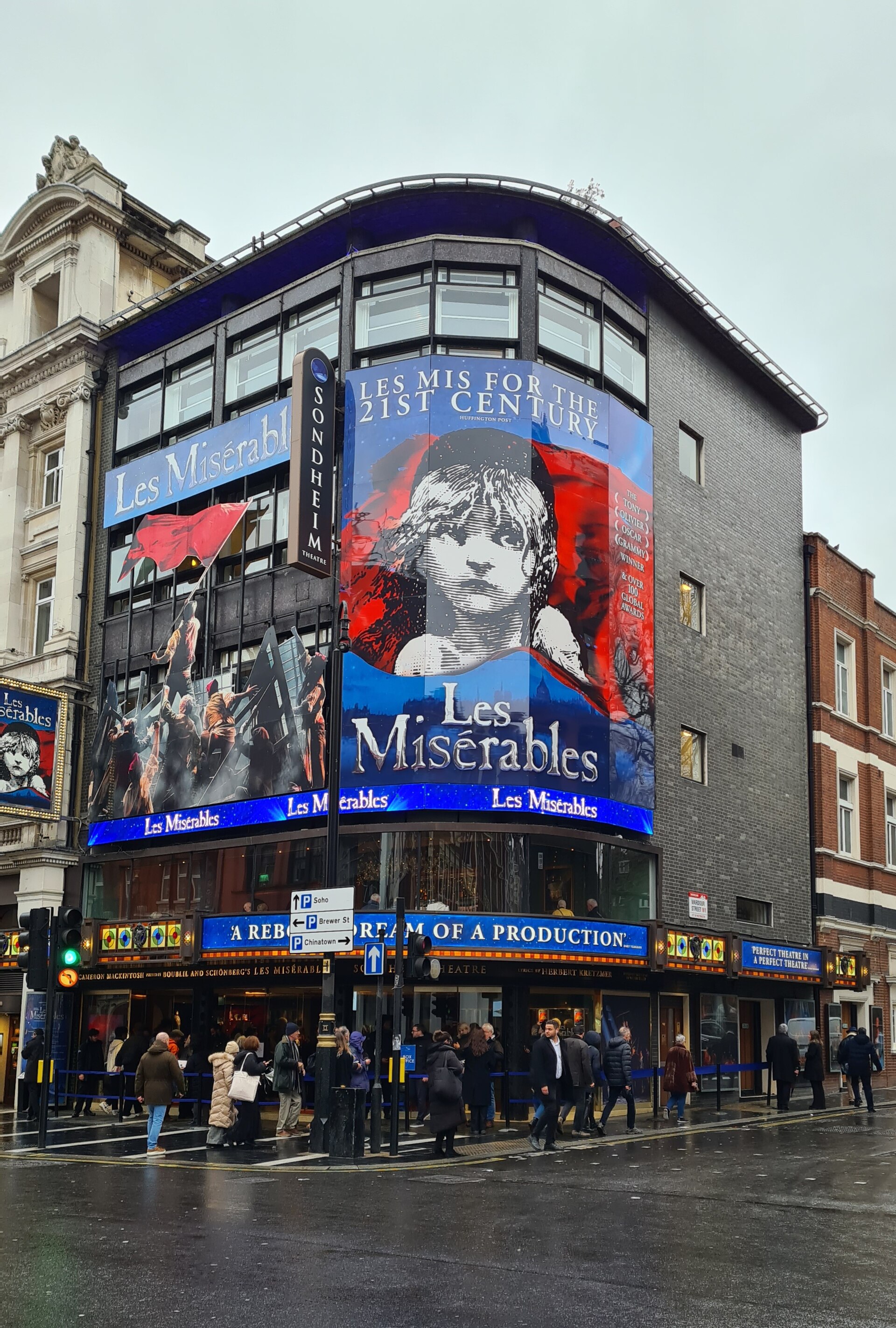
London, United Kingdom
Sondheim Theatre
Photograph by Ji-Elle, CC BY-SA 4.0.
Half of a matched pair on Shaftesbury Avenue: W. G. R. Sprague drew this and the Gielgud next door as one composition in 1907, and for its first century this was the Queen's. It has been the Sondheim since 2019, and Les Misérables has been the tenant since 2004.
Inside the Sondheim Theatre
Sprague designed it as a pair with the theatre on the adjoining corner — now the Gielgud — and opened it on 8 October 1907 with a comedy called The Sugar Bowl. For its first fifty years it was a straight-play house: the Old Vic's Hamlet transferred here in 1930 and gave John Gielgud his first Shaftesbury Avenue Hamlet, and Robert Morley's first play brought Marie Tempest, Sybil Thorndike, Margaret Rutherford and Rex Harrison onto one bill in 1935.
On 24 September 1940 it became the first West End theatre put out of action by bombing, which ended a successful run of Rebecca overnight. It stayed shut for nineteen years. Westwood Sons & Partners rebuilt it for £250,000 with Sir Hugh Casson advising on the décor, and it reopened on 8 July 1959 with Gielgud's Shakespeare recital Ages of Man — the same actor, in the same room, three decades on.
Les Misérables moved in from the Palace Theatre in 2004 and has stayed. The theatre closed for a major refurbishment in 2019 and reopened as the Sondheim, named for Stephen Sondheim's ninetieth birthday, with the restaged production that plays there now.
Opening dates, capacities and architects on this page come from the theatre's own history pages and from Wikipedia.
Getting there
Piccadilly Circus is the nearest tube; Charing Cross is the nearest railway station, and the 14, 19 and 38 stop on Shaftesbury Avenue.